AS SEEN ON SHARK TANK INDIA SEASON 5

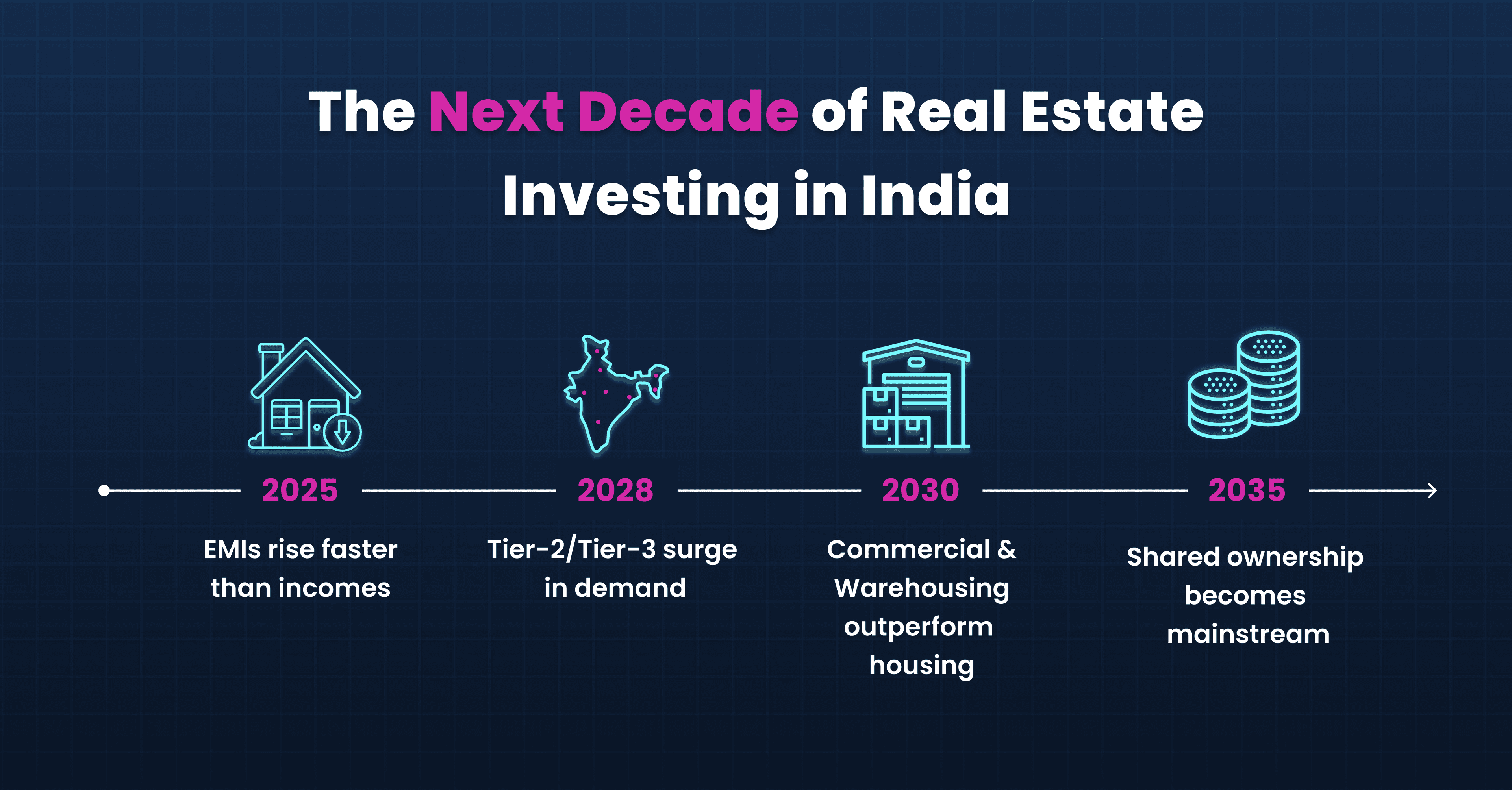
India’s real estate market is about to enter its biggest shift in 30 years, not because of a single regulation or economic event, but because the entire foundation of ownership is changing.
For decades, buying a home was the ultimate financial goal. Today, the math is breaking.
And yet, real estate remains the most trusted wealth builder for Indians.
So the old model is fading, but the desire isn’t.
Here’s what the next decade will really look like: and where shared ownership fits in.
Across metros, the price-to-income ratio has moved to a point where:
For the first time, the decision is shifting from “Where should I buy?” to “Should I buy at all right now?”
This doesn’t mean real estate is losing value. It means ownership is decoupling from residence.
Over the next 10 years, growth is expected to come from:
These categories offer what residential can’t: 8–10% yields, long leases, and business-driven demand cycles.
Add to that the massive Tier-2/Tier-3 rise: Indore, Kochi, Coimbatore, Lucknow: and India’s CRE story is only getting started.
Three slow-moving but game-changing shifts:
Does this change the industry overnight? No. But it absolutely changes the next decade.
For 30 years, Indians were told: “Buy one home. Build everything around it.”
But this meant taking a massive, undiversified bet on a single location.
Today’s investor behaves differently:
This is not speculation. It is the natural evolution of a generation that grew up with SIPs and digital-first investing.
Surprisingly yes, in ways the old system never did.
For someone earning ₹40k–₹90k/month, full ownership is out of reach in top cities.
But owning ₹25k worth of a warehouse, office, or logistics asset is suddenly possible.
Shared ownership doesn’t solve affordability. It solves access.
It gives people a way to participate in wealth creation while they rent, save, or work toward a future home.
But it’s not perfect - and it’s important to say this openly.
Shared ownership has risks:
This model works best for someone who thinks long term and invests with discipline, not FOMO.
We’re building a product for the investors who were historically left out - the working class, early earners, first-time real estate participants.
Our focus is simple:
Because shared ownership should expand opportunity - not push people into risky commitments.
The next decade isn’t about the end of homeownership. It’s about a new way to enter real estate.
A way where:
India’s working class deserves access to the same institutional-grade assets that HNIs have dominated for decades.
And the next decade is the first time that becomes possible.